
Thursday 31 October 1963
"Sensible enjoyment"
She Loves You continued its climb back up the charts, moving up to number 3 in Disc and to number 2 in New Record Mirror, which also had Cilla Black’s Love Of The Loved peaking at number 35 and The Beatles’ Hits EP knocking the Searchers’ Ain’t Gonna Kiss Ya off the top of the EP chart. NRM also had an ad for the Christmas show with a top ticket price of 18/-. The paper reviewed Billy J. Kramer’s latest Lennon/McCartney number I’ll Keep You Satisfied, predicting it would “rush straight to the top.” The prize letter in Disc’s Post Bag from Linda Hall and Denise Pettener of Gravesend read, “We are Beatle fans and members of their fan club and we used to be proud of this fact. Now we are beginning to wonder. It seems that being a Beatle fan means being associated in people’s minds with the antics of a large number of irresponsible people. Girls rush towards the Beatles as if their one idea were to send them to the casualty ward of the nearest hospital. Sensible enjoyment of their act does not require screaming from the second they walk on stage to the second they walk off. We imagine the Beatles, all in their early twenties, would like to reach the ripe old age of 30. Judging by the way some fans are behaving we doubt if they will.”
Kenneth Williams, aged 28, made life-size chalk drawings of the group on the pavement outside the National Gallery. A fellow artist tried to rub his drawings out, complaining that they were attracting a larger crowd than his Mickey Mouse. Although he had never met the group, he said, “The Beatles have given me my best financial break to date.”
Frederick Tyler, the managing director of the Brooklands Farm Hotel, placed an advertisement in the Coventry Evening Telegraph, informing the public that no tickets for the Beatles’ forthcoming visit were available to buy at the hotel. “Will fans kindly refrain from calling or ringing as this is causing great inconvenience to the staff and our guests.” Detectives in Darlington were looking into an anonymous letter sent to Pat Gibson who had started a Beatles fan club a couple of months earlier. The letter said, “So you are going to start a Beatles’ Club. How daft can you get? You are a married woman - for God’s sake grow up.”
Before the group headed to the airport to return home, Klas Burling chatted one last time with Paul and Ringo. Teen Bengt Eriksson (later a journalist at the Swedish pop magazine Schlager) took John and Neil Aspinall on a shopping trip. John bought a dark grey coat at Stroms on the corner of Sveavagen and Kungsgatan. Several fans made the twenty-five-mile journey to Arlanda Airport and mobbed the group when they arrived. The group flew back to London aboard an SAS Caravelle jet, as second-class passengers. During the flight, those in first-class came into the second-class compartment asking for autographs. When the group landed, they were greeted at London Airport by a crowd, variously estimated at anything between 1,500 and 20,000, on the roof gardens of the Queen’s Building, adjacent to Terminal 2.
Undeterred by pouring rain, the fans, some of whom had slept overnight, had been directed there by airport officials. Thirty extra police were called in and crush barriers erected to contain the crowd. “What confusion here at London Airport,” said Reg Abbis, in a breathless report filed for BBC radio. “Hundreds and hundreds of Beatles fans are shouting, yelling, waving umbrellas and hats, and shouting for their heroes, four young men in dark clothes, who had just disembarked from the huge white and blue twin jet airliner from Stockholm. The crowd of fifty photographers is at the back of the plane to capture the mounting excitement. Their flash bulbs are flashing. Now there is quite a crash at the bottom of the steps at the rear of the plane. There’s a swarm of people there as the Beatles try to force their way through. There’s a massive security precaution here to bring them to the main building. The fans are virtually going wild here on the balcony and are having a wonderful time despite the pouring rain. The Beatles are making their way towards the main terminal and waving and smiling at the crowds. The Beatles haircuts stand out for all to see.”
Anne Butler in the Daily Herald wrote, “I touched a Beatle last night. Two fans, little more than 12 years old, grabbed me later and kissed my gloved hand. The fever is now an epidemic. I trod on a Beatle too. Couldn’t help it. There was a scrum at London Airport when the group returned from their week in Sweden. The Beatle fans were at the airport to give a squealing welcome. Hundreds and hundreds of bedraggled girls and boys waited hours in the rain to see them. Officials specially arranged for the Beatles’ Caravelle from Stockholm to touch down near the Queen’s Building. Everyone who looked like a Beatle fan was directed to the rooftop gardens. For just 6d each they could watch their idols - but from a distance.” One man surveying the scene said, “The country’s gone mad. Bloody kids. Makes you sick.”
The Ministry of Aviation considered the Beatles so important that it issued a directive giving their arrival priority over Prime Minister Sir Alec Douglas-Home’s departure to Edinburgh. In the midst of the commotion, even contestants for the Miss World competition passed through the terminal unnoticed.
US TV host Ed Sullivan and his wife Sylvia, on their annual visit to London, took notice of the hubbub. He would later say, “For years we’ve visited London, and it was during one of our arrivals at London Airport that Mrs. Sullivan and I saw hundreds and hundreds of these youngsters, and I asked what celebrity was arriving. They told us that the youngsters were waiting to greet the Beatles on their return from Sweden. Always on the lookout for talent, I decided that the Beatles would be a great attraction for our TV show.” He also described seeing them as being like the time he travelled the American south and heard “the name of Presley at fairs. But these boys had people even wilder than Presley, and they didn’t have the wriggling and sex. I caught their act in England, and the reaction, and I said to my wife, ‘These boys have something, I want them’.” (Sometime during the summer, Bob Babb, Sullivan’s talent co-ordinator, had been taken by the show’s European scout Peter Pritchard, to see one of the group’s shows, so Sullivan had already been aware of them.)
Police escorted the group through Customs, and then the press snatched a few words with the group about their forthcoming appearance on the Royal Variety Show. Paul, replying to whether they would be changing any of their act, said, “We’ll have to change it, I’m sure. We can’t do the same thing all the time. We haven’t thought about what we’re gonna do yet.” John, asked about his accent and comments made by Edward Heath, said, “I’m not going to vote for Ted.” (During the group’s subsequent nationwide tour, John sometimes introduced the group “by kind permission of Mr. Edward Heath.”) To evade the swarm of fans, the group left the airport through a side staircase and then got into their Austin Princess for their journey back into London. The tyres on their van had been let down and required repairs costing £11 13s 6d, including parking charges. In the evening, George went to see Little Richard, the Everly Brothers, Bo Diddley and the Rolling Stones in concert at the Odeon cinema in Lewisham. Wearing a suede cap, with a wig underneath, fake beard, leather coat and a pair of glasses, he managed to go unnoticed. He stood in the wings watching the show, only to hear Little Richard proclaim, “I taught the Beatles how to rock!”
“An only child, I grew up with my parents in Queensland in a tiny place called Tungamull, between Rockhampton and the coast. My mother had tried to teach me violin, but I was more interested in playing with the other school kids. It wasn’t ’til my late teens, when I heard Roy Orbison’s ‘Only The Lonely’ on the radio, that I decided I wanted to be a singer/songwriter, so I bought an old guitar. I was by then working a nine to five job in the Main Roads Department in Rockhampton. A friend, Barry Coombs, showed me a few chords, and after a short stint in a local group called the Rockets I started singing solo in pubs and beer gardens on the weekends. My repertoire was mainly made up of Roy Orbison, Bobby Darin, Ray Charles, Marty Robbins, Don Gibson.
In October 1963 a friend and work colleague, Peter Egan, asked me if I had heard the latest sensation in England, the Beatles. I was a little sceptical. Having heard many predictions about ‘The next big thing’ at that time, who were never heard of again, I showed a rather cynical lack of interest. But he insisted that I listen to them, and loaned me their album ‘Please Please Me.’ He brought it to work, I played it that night and returned it the next day. Someone else had lent me an LP sometime earlier, which I kept for weeks, accidentally leaving it in the sun and had to buy him a replacement. Word had spread around the office of my negligence. I learned a valuable lesson, so I returned Peter’s copy promptly the next day.
When I heard it, I was absolutely stunned. I instantly became one of the Beatles’ greatest fans, and I have remained that way to this very day. Not long after that introduction to the Beatles, in the same year, my friend Barry had started a group called the Candy Men and asked me to join. We played at local dances, mainly the Blue Room and while our repertoire was a mixture of popular group songs of the day, that playlist was absolutely dominated by Beatle songs. There were other groups playing in Rockhampton in the rather healthy dance scene at that time, but we played far more Beatles than the others, and that certainly worked in our favour.
So that year or so amounted to a nine to five job in the Public Service, and playing and singing Beatles and other songs at night, and at lunchtime a friend, Robert Caswell, and I would go to the local record shop, Munros, and listen to all the latest releases, while discussing how we would one day leave that area and take over the world. He wanted to be a screen writer, I wanted to be a singer/songwriter. Big dreams, in a small place. Robert left soon after, and eventually wrote the screenplays for ‘The Doctor’ with William Hurt, ‘Evil Angels’ with Meryl Streep, ‘Over The Hill’ with Olympia Dukakis and many others.
About the same time, I too left Rockhampton with my wife Jill, heading for the big smoke, Sydney, and after signing with an independent record label, Sweet Peach, I broke through with a number 1 record in Australia, ‘Bonnie Please Don’t Go (She’s Leavin’)’ which was also successful in the USA and a number of other countries. I followed that with an album, on the Good Thyme label, the title track of which was ‘Rock And Roll (I Gave You The Best Years Of My Life)’, the sad tale of an unrequited love affair with rock and roll, the eventual acceptance of failure, but also a gratitude for the great times that journey had brought. I drew on many of my own times, when writing that song, especially the line, ‘Bought all the Beatle records, sounded just like Paul.’
I probably never really sounded like Paul, nor John for that matter, but in my own mind at the time I guess I wanted to think I did, and experiencing the crowd’s reactions to our humble renditions of the Beatles’ hits, it wasn’t hard to imagine anything. That song became a world hit for me, and also for the many other artists around the world, who covered it. I have to this day released a series of albums of original material, all released internationally, and covered and played by many famous artists, including Tom Jones, Mac Davis, Terry Jacks, Roger Whittaker, Harry Chapin, Rod McKuen and many more. And I continue to write, record and perform today.
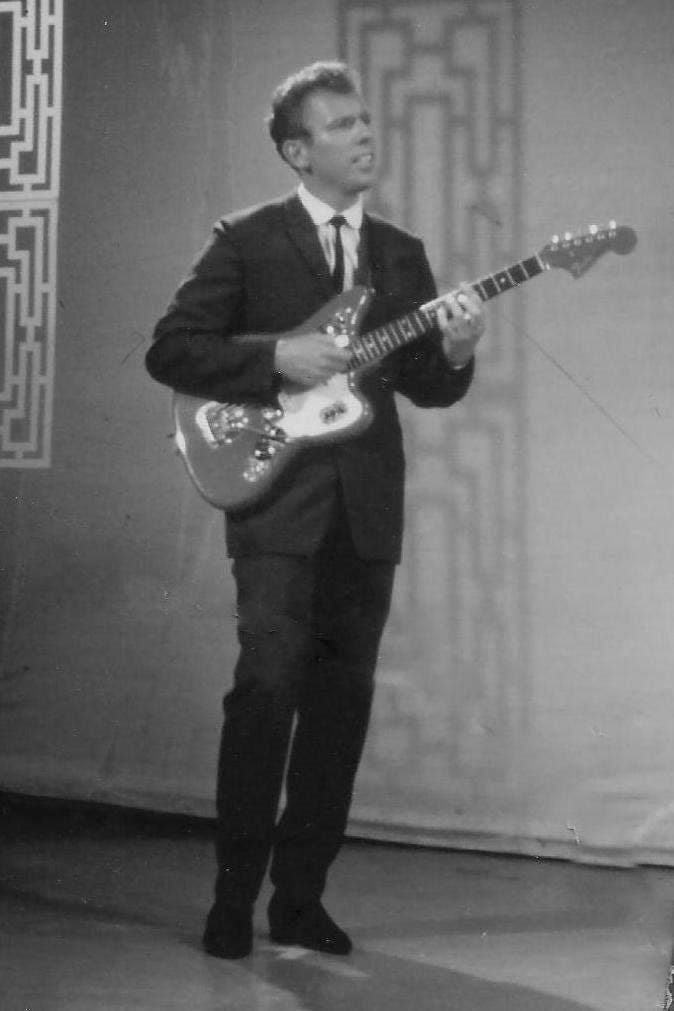
I have, perhaps subconsciously, followed the Beatles’ example, whereby there is a variety of styles, and influences of rock, ballads, country, period pieces, children’s songs like ‘Shaney Boy’ and ‘Scotty’, for our children and grandchildren, blues, folk etc. in all my albums. And in one of those albums, I once again touched on my early experiences with the Beatles, in a song called ‘Friends Of Mine.’ A tribute to my early heroes, James Dean, Roy Orbison, and of course the Beatles, summing up the positive effects they had on me, in those very early formative days. I never met any of the Beatles, although I did have a long meeting in London with their producer George Martin, who had expressed an interest in producing one of my albums. From that first introduction in 1963, to now, the Beatles have had a profound and lasting effect on me. As I sung in ‘Friends of Mine’, I may not have been a friend of theirs, but they sure were friends of mine.”
KEVIN JOHNSON, SINGER/SONGWRITER, SYDNEY, AUSTRALIA